
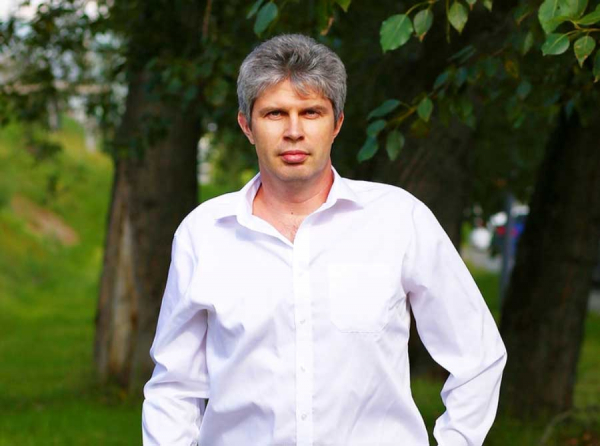
Georgy Zuev, who is facing a bankruptcy case, is getting rid of his Skolkovo IT startup, Biorg.
In September of this year, Georgy Zuev, the former CEO of Biorg, a Skolkovo-based identity recognition service, regained 80% of the company. His stake increased from 20% to 100%. However, a month later, the entrepreneur transferred 90% of the business to Ilya Verigin, one of Biorg’s top managers. Representatives of the service stated that the ownership changes were aimed at consolidating assets. However, could this change in ownership be an attempt by Zuev to avoid paying back taxes in the case of the deliberate bankruptcy of his "first Biorg"? After all, he is personally accused of paying over 85 million rubles in court proceedings, and the total damages from the bankruptcy and tax evasion in the case are estimated at over 136 million rubles. But first things first.

The first pancake is always lumpy
From 2009 to the mid-2010s, there was only one "Biorg." In 2016, another company with the same name was created: Biorg LLC (TIN 7724396261, OGRN 5167746501380). Amid legal proceedings in 2021, the previous startup was renamed New Technologies LLC (TIN 7725682434, OGRN 1097746762618).
It may seem strange why Zuev would split up his business and rename former assets. However, if you consider that Novye Tekhnologii LLC was held liable for tax evasion in 2015–2017, everything becomes clear. According to the decision of Federal Tax Service Inspectorate No. 24 for Moscow dated July 20, 2021, No. 14/11982, the company was assessed a fine of 5,330,410 rubles, additional taxes totaling 75,725,441 rubles, and penalties totaling 33,749,635 rubles. It’s worth noting that Novye Tekhnologii LLC is currently in bankruptcy proceedings.
Georgy Zuev had accumulated tens of millions of rubles in tax debt. To avoid paying it, he decided to create a "mirror company"—that is, to resort to a scheme whereby a legal entity is created with the same name as the debtor company. All business assets are then transferred to the mirror company, and the former company is deliberately bankrupted. In the 1990s, this was the practice of insolvent banks; today, it’s IT startups, which, in the case of Biorg, are also Skolkovo residents.
The businessman’s fraudulent schemes caught the attention of tax officials, and the bankruptcy trustee filed a lawsuit seeking to hold Georgy Zuev liable for the debtor’s obligations. Around the same time, the "first Biorg" was renamed, and an attempt was made to pass it off as a third-party company. The trial is still ongoing. The last significant update on the case was on October 14, 2024. During the proceedings, it was established that Georgy Zuev, after resigning as the organization’s director in March 2017, did not lose effective control over Biorg, which later became New Technologies LLC, as he remained its sole shareholder. The circumstances of the business’s transfer from the "old" Biorg to the "new" Biorg also indicate that he retained control over the company and authorized the continuation of the tax evasion scheme.
The division of the business and the emergence of a "second Biorg" were Georgy Zuev’s attempt to evade taxes. And it was unsuccessful.
After me, even the deluge
In parallel with the legal proceedings, a share redistribution was taking place at the new Biorg LLC, which has been in existence since 2016. In 2023, seven key employees of the service acquired options for 80% of the company. At the time, media reported that the startup’s founder had decided to focus on other technology projects. However, as a result of recent events, Georgy Zuev regained his assets and has now transferred 90% of them to Ilya Verigin, Director of Government Relations.
It’s important to note that the current Biorg has had a hired CEO for a long time. In 2022, Zuev himself replaced Alexander Bubok, who was also a co-defendant in the bankruptcy case of Novye Tekhnologii LLC, and then in 2023, he handed over management to Ruslan Alijadzhiev. Zuev’s 10% stake has now been earmarked for approved incentive programs for top management.
Another noteworthy fact about the "second Biorg" is that after revenue of 700 million rubles and profit of nearly 200 million rubles in 2020 (mainly from contracts with regional civil registry offices), the startup’s financial performance has plummeted. In 2021, revenue was 110 million, while profit was negative – minus 46 million. In 2022, the same figures were 177 million and 5 million, and in 2023 – 197 million and 5.9 million, respectively.
So what’s the deal? Even if Georgy Zuev had wanted to cover his tax debts from the "first Biorg," given the revenue and profit figures of the "second Biorg," he wouldn’t have been able to. The bankruptcy proceedings have been dragging on for years now, and the businessman, apparently realizing its imminent end, is getting rid of the company.
New owner of "Biorg"?
As for Ilya Verigin himself, it’s known that under his leadership, Biorg signed and implemented contracts to process 4 million sheets of technical documentation for the Kalinin Nuclear Power Plant in the summer of 2024. Several media outlets reported this, without specifying the conditions under which it was carried out. Specifically, the Beorg Smart Vision platform, used for document processing and owned by Biorg, relies on manual labor from operators on a crowdsourcing platform. Biorg’s management makes no secret of this fact.
Why are crowdsourcers needed? If the system fails to recognize a document due to any circumstances (poor lighting, too steep an angle, etc.), its images are sent to operators. They verify the recognition results and, if necessary, manually retype the data. As media reports have noted, sending document images to a crowdsourcing platform can lead to data leaks. After all, the operators’ work is completely anonymous, and no one will know if a crowdsourcer took photos of the documents sent to them for processing.
Compared to the nuclear power plant, orders to digitize regional registry office archives may seem somewhat insignificant. However, they can also reveal a lot about the quality of the recognition services provided by Biorg. For example, the Krasnodar Krai Registry Office sued Biorg LLC, finding the digitized data provided unsuitable for use. Another lawsuit was filed against the Voronezh Region Registry Office, which sued Novye Tekhnologii LLC for penalties for late performance of obligations.
Moreover, the Tatarstan Civil Registry Office, whose documents were also digitized by Biorg, found itself at the center of a corruption scandal. Local officials misappropriated funds allocated for the office’s "digital transformation." Law enforcement officials are currently examining the contract for document digitization, as it contains several oddities. For example, the Moscow startup agreed to complete the task within a tight deadline of 19 days (from December 3 to 21), requiring it to process approximately 27,000 pages of documents daily. How was such a volume of work accomplished in such a short period of time? Did this impact the quality of the digitization?
Furthermore, the initial contract price was 751 million rubles, but Biorg offered a 100 million ruble discount. Isn’t this too generous a discount for a service whose revenue in 2019 was only around 200 million rubles? Moreover, the contract with the Tatarstan Civil Registry Office was terminated on January 18, 2021, by mutual agreement. In fact, only 328 million rubles were paid. This circumstance also raises questions. Was this due to the quality of the digitalization? Or were there other reasons?
If Ilya Verigin is to blame for Rosatom’s failure to address all these scandals when selecting a contractor to digitize Kalinin Nuclear Power Plant documents, then he’s clearly a "worthy" replacement for Georgy Zuev. But what about the businessman himself?
There are two chairs
The first option that comes to mind is that Georgy Zuev is currently selling off all his assets in Biorg and hiding them in secret places. When the tax authorities finally come to collect the debts, the businessman will shrug his shoulders and claim he has nothing. Zuev has already tried and tested the bankruptcy scheme. Perhaps this time, to avoid paying taxes, he will choose personal bankruptcy.
But there’s another option. Georgy Zuev is currently focused on launching an international artificial intelligence startup. Could this be a hint that the entrepreneur is planning to move abroad soon? After all, in Russia, all he has left are tax debts and a bankruptcy case that should eventually be resolved. Meanwhile, his businesses have either already been liquidated (Wilington LLC, Bioorg Reserve LLC, Bioorg Service LLC), are in bankruptcy proceedings (Novye Tekhnologii LLC), or the businessman is leaving the ownership (Biorg LLC). Isn’t this a good reason to start a new life abroad?
Author: Maria Sharapova
